
Quick answer: A pressure reducing valve or pressure regulating valve (PRV) is used on the main water line coming into your home to prevent the pressure from exceeding the limit set on the valve, that limit is usually set between 50-70 psi. This protects the entire water distribution system and fixtures in your home from premature failure.
What does a pressure reducing valve do?
Water utilities have to push water through miles of pipe and up hills, so the pressure in the street main is often much higher than your home’s plumbing is designed to handle. A PRV sits between the street and your house and acts like a gatekeeper. No matter how hard the water is pushing from the street, the PRV lets through only as much pressure as it’s set for.
Without one, or with one that has failed, high pressure works on your plumbing 24 hours a day. It wears out faucet cartridges and toilet fill valves early, strains supply hoses on washers and dishwashers, causes banging pipes, and can lead to leaks and burst lines.
Where is my pressure reducing valve?
A PRV is installed on the main water line, usually just after the main shutoff valve where the water line comes into the house. In most homes around here, that means:
- In the basement or crawl space, on the wall where the main line comes through the foundation, often near the water meter
- In a utility room or garage on slab homes
Most residential PRVs are bell-shaped brass valves with a bolt or adjusting screw sticking out of the top, like the one in the photo below. They’re often labeled with a pressure range or a factory setting.
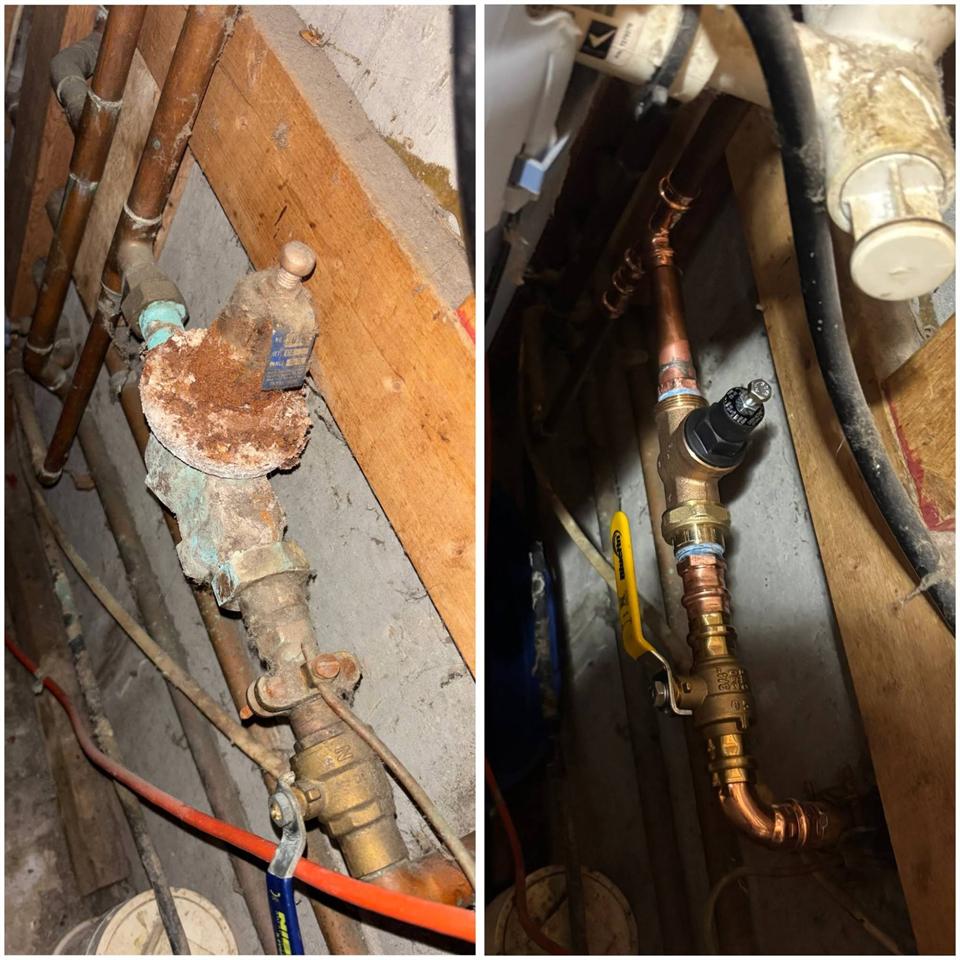
That photo is a PRV our crew replaced. The old valve on the left was buried in corrosion and mineral buildup. Once a PRV gets that far gone, the internal parts can’t move freely and it can no longer regulate pressure reliably. On the right is the new PRV with a new full-port ball valve, connected with press-fit copper fittings.
How does a PRV work?
Inside a PRV is a spring pushing against a flexible diaphragm. The spring holds the valve open, while water pressure on the house side pushes back against the diaphragm. When pressure in your home climbs to the set point, it pushes the diaphragm far enough to close the valve down. When you turn on a faucet and the pressure drops, the spring opens the valve again to let more water through. It’s a simple, mechanical design with no electricity involved, constantly balancing itself many times a day.
The adjusting screw on top changes how hard the spring pushes, which raises or lowers the pressure setting.
What water pressure should my house have?
- 50 to 70 psi is the comfortable, safe range for most homes, and it’s where most PRVs are set.
- Over 80 psi is too high. Most plumbing codes require a PRV when the incoming water pressure is over 80 psi.
- Under 40 psi usually feels weak, especially when two fixtures run at once.
Street pressure can vary a lot from one neighborhood to the next. It depends largely on how far below the water tower or pump station a home sits. Homes in low-lying areas like river towns and valley bottoms often see much higher pressure than homes up on the hill, which is why two houses a few miles apart can have very different needs.
How to check your water pressure
You can test your own water pressure with an inexpensive pressure gauge from any hardware store. Get one with a garden hose connection.
- Make sure no water is running in the house: no faucets, toilets filling, washer or dishwasher.
- Screw the gauge onto an outdoor hose spigot or the washing machine’s cold water connection, and turn that valve on fully.
- Read the gauge. That’s your home’s static water pressure.
Pro tip: Buy a gauge with a red “maximum” needle and leave it on overnight. Pressure that looks fine in the afternoon can spike overnight, either because a failing PRV is creeping open or because of thermal expansion from your water heater (more on that below). The red needle catches spikes you’d otherwise miss.
Signs your pressure reducing valve is failing
PRVs usually fail in one of two ways: they stop holding pressure back, or they stop letting enough water through.
Signs of pressure that’s too high
- Banging or hammering pipes when a faucet or appliance shuts off
- Toilets that run or refill on their own
- Dripping faucets and shower heads, even after new cartridges
- The relief valve on your water heater dripping or discharging
- Water that blasts out of faucets
- Leaking or failed supply lines on washers, dishwashers, ice makers or toilets
Signs of pressure that’s too low or unstable
- Weak flow throughout the whole house, not just one fixture
- Pressure that surges and drops, or shower temperature swings
- A humming, buzzing or vibrating noise near the main line when water runs
Also look at the valve itself. Water dripping from it, heavy corrosion like the “before” photo above, or crusty mineral buildup around the adjusting screw are all signs it’s near the end of its life.
How long does a PRV last?
Pressure reducing valves commonly last around 10 to 15 years. Hard water and sediment, which are common in Southeast Indiana and the tri-state, can wear out the internal seat, diaphragm and strainer sooner. If your home is 15 or more years old and the PRV has never been replaced, it’s worth having your pressure checked.
Can I adjust my PRV myself?
Most PRVs can be adjusted. You loosen the lock nut on top, then turn the adjusting screw: clockwise raises the pressure and counterclockwise lowers it. Then you re-check with a gauge. A small adjustment on a healthy valve is a reasonable DIY job.
That said, adjusting a worn-out PRV won’t fix it. If the valve is old, corroded or creeping, the screw may not change anything, or the pressure won’t hold where you set it. Cranking on a corroded valve can also start a leak. If an adjustment doesn’t solve the problem, the valve needs to be replaced.
PRVs and your water heater: don’t forget thermal expansion
Many PRVs keep water from flowing back out to the street, which makes your home’s plumbing a “closed system.” When your water heater heats a tank of water, that water expands and has nowhere to go, so pressure in the whole house spikes. That’s a common reason the relief valve on a water heater drips.
The fix is a thermal expansion tank, a small tank on the water heater’s cold supply line that absorbs the extra volume. Plumbing codes typically require one on closed systems, so when we install or replace a PRV we also check the expansion tank. You can see one mounted above the water heater in the utility-room photo on our water heater services page.
PRV repair vs. replacement
Some PRVs can be rebuilt with a kit, and cleaning a clogged strainer can restore low pressure. For an older valve, or one with corrosion like the one in our photo, replacement is usually the better long-term value. A new valve resets the clock on the internal parts. Replacement involves shutting off the water, cutting out the old valve, installing the new one, often with a new shutoff valve while the water is off, and then setting and testing the pressure. It’s typically a same-visit repair.
Pressure reducing valve FAQs
Does every house need a pressure reducing valve?
No. A PRV is needed when the pressure coming from the street is too high, generally over 80 psi. Many homes on city water have one, but some don’t need it. A pressure test tells you for sure.
Do homes on well water need a PRV?
Usually not. On a private well, water pressure is controlled by the well pump’s pressure switch and pressure tank, typically set somewhere around 40 to 60 psi. If a well system’s pressure is off, the pressure switch or tank is the place to look.
Is a pressure reducing valve the same as a pressure regulator?
Yes. “Pressure reducing valve,” “PRV,” “pressure regulator” and “water pressure regulator” all describe the same valve. It’s different from the relief valve on a water heater, which is a safety valve that opens to release dangerous pressure or temperature.
What happens if a PRV fails?
Most often the valve stops holding back street pressure, so pressure in the house creeps up. That causes the leaks, running toilets, banging pipes and appliance failures described above. Less often, a failed or clogged PRV restricts flow and causes low pressure. Neither is usually an emergency, but high pressure should be fixed soon because it slowly damages everything connected to your plumbing.
Think your water pressure is off? Diamond Plumbing tests water pressure and repairs or replaces pressure reducing valves and expansion tanks across Southeast Indiana, Greater Cincinnati and Northern Kentucky. Call (513) 328-3318 or book online. Learn more about our plumbing repair services.